Friday, 9 July 2010

Shiomomi nasu: Salt-massaged eggplants with Japanese aromotics


I have been addicted to nasu (Japanese eggplants) this last while. They are everywhere at the moment, and the cooking magazines (which I really have to stop tempting myself by looking at) have 101 different ways to use them. The "Mighty Nasu" indeed (to paraphrase one of my foodie heroes Ottolenghi).

Yes, the eggplant/aubergine/patlican/baademjaan/badinjaan/baingan/ brinjal is beloved to many cuisines, but have you ever had it raw?? Most of the world makes a fuss about removing the bitterness from eggplants before cooking them, but here in Japan, it couldn't be easier: Just squish around in a bag with salt! The dark, bitter juices come right out, and you don't even need to cook them. How good is that?

This quick side dish recipe is from the June 17, 2010 edition of the Japanese food fortnightly Orange Page (don't ask; I'm as mystified by the name as anyone...). I thought it not bad, for my first attempt at salt-massaged eggplants, but with the Japanese big three aromatics shiso (perilla leaves), myoga (myoga ginger) and raw fresh ginger, it may be a bit "medicinal" for some tastes.

The trick to this dish is to make sure that all the eggplant slices get massaged well, and to slice the aromatics very finely.

I haven't tried this with the larger eggplants that you tend to find outside Japan, which are called bei-nasu (American eggplant) in Japan. For now, I suggest you seek out small, round Japanese nasu, which weigh about 80-100 g each.

Salt-massaged eggplants with Japanese aromatics

Serves 4 as a small side dish with other Japanese dishes

2 nasu Japanese eggplants (about 160 g total), sliced into 2 mm thick rounds
2/3 tsp salt
3 shiso (perilla) leaves, rolled and sliced very thinly
1 myoga (myoga ginger) bud, halved lengthwise and sliced thinly
1 thumb-sized piece of fresh ginger, peeled and chopped into thin shreds
splash of Japanese soy sauce (to taste)

1 Place the eggplant slices in a small polythene bag and add the salt. Press out all the air and hold the opening of the bag tightly closed with a thumb. With both hands, gently squeeze the eggplant slices until they loose their juices, most of their bulk and become pliant. Make sure not to miss any of the slices. Tip into a colander and rinse with water. With your hands, squeeze out as much of the water as possible.

2 In a small bowl, toss the shiso leaves and myoga. Add the salt-massaged eggplant, sliced ginger and a splash of Japanese soy sauce. Toss again and serve in tiny bowls as an accompaniment to other Japanese dishes.

Enjoy!

Thursday, 8 July 2010

Harumi's summer: Rice bowl with stir-fried veggies & teriyaki chicken

I must not buy cookbooks and foodie magazines, I must not buy cookbooks and foodie magazines, I must not buy...

And the reason I must not buy them is that I have been asked by the landlady to move out of my rented apartment after 15 years, as she wants to move in! I really don't know who she thinks she is! It is a terrible imposition, this not being able to buy cookbooks and--- (you get the picture).

I know it in my mind that I need to be shedding rather than adding to my foodie hoard, but heart wants what it wants. All of which is to say, I couldn't resist the latest edition of Haru-mi magazine, Harumi Kurihara's eponymous quarterly featuring, this time, izakaya-style recipes for summer.

Surprisingly, summer cooking in Japan does not necessarily mean light food. The humidity and high temperatures here can really zap the energy, and quite often people want a hearty meal to get them through the dog days of summer. Grilled eel is a case in point: Some enterprising eel purveyor back in the 1800s hit upon the idea of flogging his oil-rich catch as just the thing for boosting flagging energy levels during the summer. And just like that, a connection was made between eel eating and Doyo no ushi no hi (the hottest day of summer by the traditional Japanese calender; July 26 this year).

But I digress.

As I was saying, Japanese people often seek out substantial, well-seasoned food when the temperatures soar, so it is no surprise that quite a few of the dishes in the summer edition of Haru-mi are fairly hearty. This rice bowl being a case in point.

With a soy-and-sugar seasoned mince topping AND slices of teriyaki chicken, you might expect this to be stodgy, but the herbs and lemon keep this meal-in-a-bowl on the right side of the line.

The recipe does require some Japanese groceries, so do read it through first.

-- Mirin is a sweet sake used extensively in Japanese cooking. If you can't get it, you could try this substitute, just a plain sugar syrup or a dash of sugar at a pinch (but I wouldn't recommend this in this recipe).
--Katakuriko (dogtooth violet or more commonly potato starch) is used for thickening sauces and, as in this recipe, to give a distinctive mouthfeel.

On the other hand, you won't need store-bought teriyaki sauce for this recipe. Yay!

Rice bowl with stir-fried veggies & teriyaki chicken

For the ground meat topping

200g beef or pork mince
2 tbsp Japanese soy sauce
2 tbsp mirin
1 tbsp sugar

For the stir-fried veggies
100 g bean shoots, roots removed
1/2 small zucchini, cut into 4 cm long batons
1 small red (bell) pepper, halved and cut into thin slices
1 tbsp vegetable oil
1/4 tsp powdered chicken stock
salt & pepper

For the teriyaki chicken
4 chicken fillets
salt & pepper
Katakuriko or cornflour (cornstarch), for dusting
2 tbsp Japanese soy sauce
2 tbsp mirin
2 tsp sugar

steamed rice
lemon halves
coriander leaves, mint leaves and toasted sesame seeds (optional) to garnish

1 Make the ground meat topping. Heat Japanese soy sauce, mirin and sugar in a small pot, add the mince and stir, breaking up with bamboo cooking chopsticks, until most of the liquid has evaporated. Remove from the heat and allow the meat to absorb the remaining liquid.

2 Prepare the bean shoots, zucchini and red pepper.

3 Make the teriyaki chicken. Remove any fibrous parts from the meat, place between layers of cling film and flatten with a rolling pin [Saffron: lazy folk, like me, can just flatten the fillets right on the chopping board with the heel of their hand (I won't tell, if you don't)]. Cut each slice in three width wise. Sprinkle with salt and pepper, and dust each piece with katakuriko or cornflour. Heat oil in a frying pan and fry chicken on both sides. Remove from the pan.

4 Wipe out the frying pan and bring the Japanese soy sauce, mirin and sugar to a boil. When it becomes glossy, add the cooked chicken and toss well to coat. Remove from the pan.

5 Heat a little more oil in the pan and toss the zucchini and red peppers until slightly softened. Add the bean shoots and toss until heated through. Add powdered chicken stock and salt and pepper to taste.

6 Place a single serving of rice in each of 4 domburi or pasta bowls. Top each bowl with a layer of vegetables and a layer of the ground meat topping, sprinkle with coriander and mint leaves, and place the chicken slices on top, sprinkling over any teriyaki sauce that remains. Squeeze lemon over and garnish with sesame seeds, if desired.

Enjoy!

Monday, 17 May 2010

Persian cooking class 2: Nan-cheese-herbs, fesenjan & rose jam


I was super excited about my most recent Persian cooking class, as it was fesenjaan again! After my success with Najmieh Batmanglij's recipe in February, and after seeing our instructor Reza cooking this version on the NHK program Asia Crossroads, I was more than ready for another plate of Iran's classic party dish.

Reza's version, which somehow came to be dubbed "pomegranate curry" in Japanese, is certainly simpler than Najmieh khanom's. Onions and chicken are sauteed, and then spices and roughly chopped walnuts added. The chicken is removed, water added and the onion-nut mixture left to simmer for 20 min. It is then ground into a paste in a food processor or blender, making the sauce base. The chicken is returned, pomegranate paste and saffron water added and the lot left to simmer some more. The food processing bit seemed a bit radical to me, but certainly resulted in a smooth and dark sauce, so it looks like a winner.

None of my Japanese classmates had had fesenjaan before and were, I think, very pleasantly surprised by the combination of pomegranate and walnuts. In any event, there was a great deal of chatter about it round the table. Sour notes are not especially well represented in main dishes here, other than vinegared dishes like sushi, I suppose. No doubt an Iranian would probably have a similar reaction when presented with vinegared rice!

Speaking of rice, saffron rice was also on the menu, and the Iranian way with rice was another hot topic with my classmates. Japan is no stranger to rice, of course, but I can't think of any dish where boiling and draining the rice occurs. Grains that just hold together are preferred to separate grains, which would be much more difficult to corral with Japan's pointed chopsticks.

All of us had a surprise with our teacher's chosen method of cooking the nan for nan panir sabzi (bread, cheese and herbs), which was the appetizer for the evening. Flour tortillas (which being readily available, do duty as all kinds of flat breads) were toasted on a stove-top griller that's normally used for grilling fish here in Japan. Apparently it's the best way he's found of crisping up nan in Japan. There's a bit of a knack to getting the tortillas to puff up, but it works a treat. Must tell my dear Indian friend Sm next time he's in Japan!

Our last treat for the evening was rose jam. How wonderful to know that you can make jam from dried rose petals (or even rose "tea"! The roses here (even in Yokohama, which claims the bloom as it's city floral emblem) don't have a lot of perfume, let alone taste...

The dried rose petals are soaked in water for 3 hours, so you need to plan a bit in advance. Other than that, it's just sugar, rosewater and lemon or lime juice. But oh, oh! What a flavour. Although we had it with ice cream, rose jam is equally delicious on pancakes, bread and stirred into yogurt.

In Iran, of course, fresh rose petals are used, and it seems that when they are in season you get them from the veggie shop. How great would that be??!


Wednesday, 12 May 2010

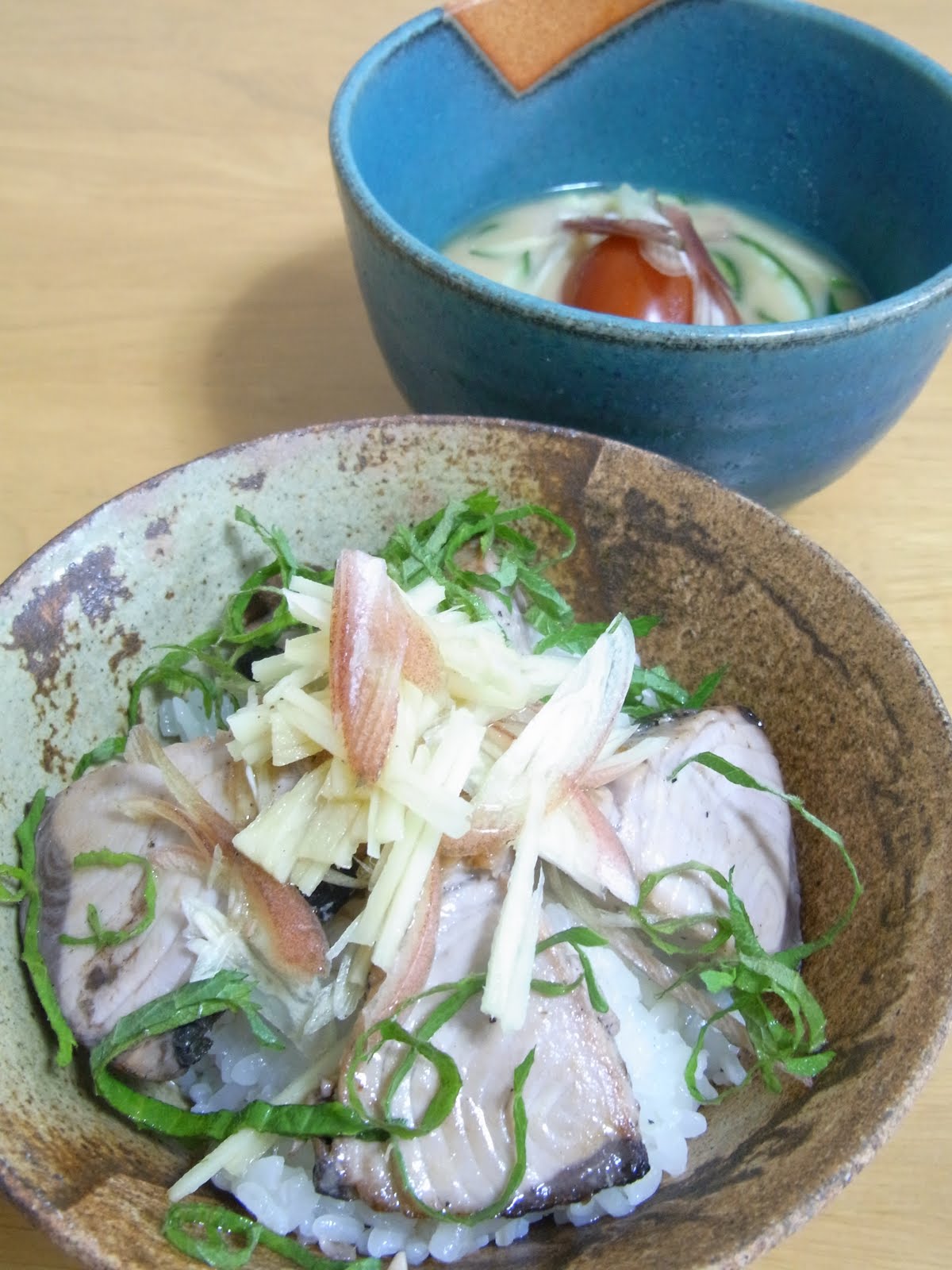
Bonito bowl with Japanese aromatics and chilled miso soup with summer vegetables


This is a recipe I learned around this time last year at the Japanese cooking classes I was taking at ABC Cooking Studio. It's a blow-you-away explosion of flavour that really wakes the tastebuds up!

Unfortunately, it contains some traditional Japanese aromatics that might be difficult to find outside the country. For green perilla (shiso), you could try substituting basil or even Thai basil, but there's not really any substitute for myoga (the bud of a ginger plant) that I know of. I've seen celery suggested, but other than a little crunch, I don't see any commonalities with myoga. Certainly, I wouldn't want celery with this dish, but to each their own. You'll also want to seek out ponzu or make your own instant ponzu by combining citrus juice (citron juice, for preference), soy sauce and unsalted dashi stock in a ratio of 1:1:1. (Or you could go the whole hog and make bottleable ponzu using this recipe, but that might be one to save until autumn, when citron is in season (g)) .

Katsuo no tataki, or bonito that has been seared on the outside and dunked in an ice bath to ensure that it is still raw inside, is sold in triangular ready-to-use blocks at Japanese supermarkets. You could try tuna or horse mackerel if bonito is not available, but there's no need to do the searing and ice bathing routine for this recipe, as the fish will be lightly fried in any case.

This went very nicely with chilled miso soup with summer vegetables, another ABC recipe. Chilled miso is a specialty of Miyazaki Prefecture, although this recipe seems to be a pared back version. There's no cooking involved in this, so it's perfect for a muggy Japanese summer's evening. I say the recipe is for 3-4. ABC recipes are often so calibrated that the portions of each dish can be rather small. The original recipe is for 4, but the Young Man and I pretty much polished this off between us in one sitting. Greedy guts that we are (g).

Just a quick note about surigoma or ground sesame seeds. You can buy ready-ground sesame seeds in Japanese supermarkets, but the flavour is better if you toast and grind them to a fine powder yourself.

Bonito bowl with Japanese aromatics

Serves 3-4

200 g katsuo tataki or tuna or horse mackerel
1 tsp vegetable oil
2 tbsp ponzu

200 ml short-grain rice
200 ml water

For the aromatics
4 green perilla leaves (ao-jiso)
12 g fresh ginger
1 myoga (aka myoga ginger)

1 g shredded nori (optional)
12 g garlic, sliced and deep fried (optional)

4 tsp ponzu

1 Wash rice 4-5 times until the water runs clear. Cover with water and leave to soak for around 30 minutes, drain, then cook in a rice cooker with the measured water.

2 Prepare the aromatics. Cut the stalk out of the perilla leaves, stack one on top of the other and roll together to form a "cigar". Slice finely into shreds. Peel the ginger and finely julienne. Soak briefly in water, then drain. Cut the stalk off the myoga, halve lengthwise and slice finely on the diagonal. If using garlic chips, peel each clove and slice into rounds. Punch out any green part with a chopstick. Deep fry until golden brown at 160 degrees C, then drain on kitchen paper.

3 Cut slices from the bonito block about 7 mm thick. Heat vegetable oil in a large frying pan and cook bonito slices briefly, turn and cook the other side (about 2 min total). Remove to a bowl and pour over 2 tbsp ponzu.

4 To assemble, divide rice between bowls, top with bonito slices, shiso, ginger and myoga. Garnish with shredded nori and garlic chips, if using, and sprinkle 1 tsp of ponzu over each bowl.

Chilled miso soup with summer vegetables

For the soup
2 g dashi konbu (dried kelp for stock)
220 ml water
24 g miso paste (mixed miso, for preference)
2 tbsp white surigoma (roasted sesame seeds ground to a course powder)
1/2 tsp raw sugar

2 ripe fruit tomatoes or other mid-sized tomatoes, peeled
1/2 Japanese cucumber (around 50 g)
1 myoga bud

1 Make the dashi. Wipe the kombu with a damp cloth and make cuts in 2-3 places to help the flavour come out. Place in the water and leave for at least 30 min.

2 Prepare the vegetables. With a sharp knife, cut the tomatoes in half through the stalk end, then cut shallow crosses in the rounded side of each tomato half. Slice the cucumber thinly on the diagonal, then cut the slices lengthwise into shreds. Cut the stalk off the myoga and halve lengthwise. Cut each half into thin slices on the diagonal.

3 Make the soup. With a whisk, blend the miso, sesame paste or tahini and raw sugar until smooth. Gradually stir in the kombu dashi. Chill until ready to serve.

4 To serve, place tomato halves in four bowls with the rounded side upwards. Divide the soup between the bowls and top each tomato half with the cucumber and myoga.

Enjoy!

Friday, 23 April 2010

Persian cooking class!


A serendipitous series of events led me to discover that a Persian cooking class is being held right here in Tokyo!

And even more exciting, the instructor, Reza Rahbar, is from down south in the Persian Gulf region of Iran. The Persian cookbooks in my collection do not cover this area of the country, and from the recipes Reza presented on the Ajiwai Kitchen segment of the NHK program Asia Crossroads in April, I knew I was in for something a bit different!

The class was held in a private apartment in swanky Aoyama, just a couple of stops by subway from my office. It was a very homey atmosphere, with a dining table set for 6 and a small hob where the cooking demonstration and hands-on cooking took place.

Reza-sensei was a charming host and very laid back in the kitchen, answering my barrage of questions as we went along.

The first dish we made were adorable kupeh fried rice cakes stuffed with a delicious filling of mince, onions, yellow split peas, sultanas, saffron and cinnamon (photo above). The aroma was very much like that of my favourite adas polo (rice with lentils and dried fruit). I wondered if they also eat adas polo where kupeh are from, and it seems they do. A variation on a theme, then.

The assembly of these little parcels is quite fiddly, but the resulting packets were like tah-dig sandwiches. Delicious.


Next, we made sandali soltan ("the Sultan's seat"), a puree of garlic and turmeric-infused broad beans that was topped with ground dried lemons and sizzling olive oil, giving that unmistakable Persian tartness. I was surprised to know that this relative of the myriad purees, pastes and dips that feature heavily in non-Persian Middle Eastern meze, is considered a borani. I had thought that borani were all yogurt "salads". There you go!

With glasses of wine (at a small extra cost), we ate this with fresh chives and crackers, although it would probably have been lavash in Iran. Great stuff.


The other two dishes were a delectable stew of layered lamb, vegetables and prunes, which had been prepared in advance due to time constraints; and a dessert of dates stuffed with almonds and dusted with rosewater, coconut and cardamom that Reza prepared while we ate the first two courses, all washed down with Persian tea and saffron sugar crystals.

At the end of the meal, we were all happily sated and eager for the next session.


This was a trial lesson for me, but I think I was sold the moment I walked in the door to such a warm welcome, knowledgeable host, and the thoughtful offer of wine. A designer by trade, Reza had personalized our recipe sheets with beautiful artwork, and even presented us all with a thank you gift of two dried lemons in a presentation bag with a tag of his own design.

It was a lovely finishing touch to what had been a very enjoyable session of cooking with (new) friends. I signed up for more on the spot (g).

Sunday, 18 April 2010

Diana Henry's lamb and orange khoresh

Add Image
When I wrote about Margaret Shaida's Orange khoresh back in January, I knew I would have to revisit the version in Diana Henry's Crazy Water Pickled Lemons. Diana's version of orange stew was one of my very first forays into the wide world of Middle Eastern cooking. It really opened up my eyes and taste buds to how good the eating is in that part of the world!

There is some kind of alchemy involved in this dish. Other than orange flower water (which I consider optional, as it makes little difference to the taste in all honesty), there is nothing out of the ordinary in this recipe, but for a citrus lover like me, the results are nothing short of phenomenal!

Diana does not give a source for her recipe, but she's definitely done her homework, and perhaps even bettered the other versions of this delightful dish that I've tried since. Her addition of mint is inspired (whatever made her think of adding mint to lamb...? (g)), and really lifts this dish onto a higher plain. I use teeny, tiny peppermint leaves, which do take some prepping, but I think it's worth it.

On the other hand, Diana saves us some time by only boiling the orange peel once to remove the bitterness. Most recipes call for several changes of water to do this job. However, since we are using lamb here, it can take the stronger orange flavour very well.

I've adjusted Diana's recipe for the pressure cooker. The meat will take roughly double the time to cook in step 3 if simmering without pressure.

All in all, I would say that this is my favourite orange khoresh, if not one of my very favourite things to eat. If it takes a little time to make, I'm not going to complain. It is a joy to make something so very good to eat.

Lamb and orange khoresh

Serves 6

3 oranges
40 g unsalted butter
2 tsp caster sugar
olive oil
675 g lamb from the leg, cut into 3-4 cm cubes
2 onions, thinly sliced
1 tsp ground cinnamon
1/2 tsp ground cardamom
275 ml orange juice
Juice of 1 lime
275 ml lamb stock or water
salt and pepper
3 carrots
good handful of mint leaves, torn
2 tsp orange flower water
25 g shelled pistachios, roughly chopped, to garnish

1 Remove peel from the oranges with a vegetable peeler, taking care to leave the pith behind, and cut into fine strips about the size of a match. Cover with cold water, bring to the boil, cook for 2 min, then strain. Heat half the butter in a a small pan and add the orange rind. Stir, then add the sugar and cook over a medium heat for a couple of minutes, until the sugar has melted and the rind has lightly caramelized. Set aside.

2 Heat 2 tbsp of olive oil in a heavy-bottomed pressure cooker. Fry the lamb cubes over fairly high heat, so that they get a good browning on the outside. You should do this in batches to ensure that they get properly coloured. Remove and set the lamb aside.

3 Add another 1 tbsp of olive oil to the pressure cooker with the rest of the butter. Heat this and saute the onion until soft and translucent. Sprinkle on the cinnamon and cardamom and cook for another minute. Add the juices, stock and water, and the lamb, with any juices that have run out of it. Season, seal the pressure cooker and and bring up to pressure. Turn down the heat and cook at low pressure for 40 min.

4 Peel the carrots and cut them into batons about 6 cm long. Using a very sharp knife, remove the white pith from the oranges then, cutting close to the membrane, remove each segment. Add the carrots and caramelized orange peel (reserving a little for garnishing) to the lamb once it has been cooking 40 min. Simmer, uncovered, for a further 20 min, adding the orange segments in the last 10 min. Gently stir in half of the mint in the last couple of minutes.

5 Stir the orange flower water, if using, into the khoresh and turn it into a heated bowl, scattered with the remaining mint and orange peel and the pistachios. Serve with plain white rice.

Enjoy!

Monday, 22 March 2010

Aash-e reshteh: Ottolenghi's take on the Persian soup


Happy Persian New Year! It's No Ruz again and that means aash-e reshteh (Iranian noodle soup) at the Saffron household.

A couple of weeks back, Yotam Ottolenghi posted this recipe for legume and noodle soup in his New Vegetarian column on the Guardian website. One look at the picture and I was mitten. It wasn't until I read through the recipe that I realized it was the Ottolenghi take on aash-e reshteh! And just in time for the spring equinox, and No Ruz. I knew I had to try it!

Chock-full of greenery to celebrate the arrival of spring, I have always thought of aash-e reshteh as a herb and spinach noodle soup, but I guess there are other interpretations (g). With three different legumes--chickpeas, butterbeans and yellow split peas--legume-lovers will certainly cheer at Ottolenghi's version (g).

The soup has a lovely velvetiness from the yellow split peas and is garnished beautifully with turmeric onions (you could also add some dried mint to the onion garnish, as Najmieh-khanom does), sour cream and a few reserved butterbeans and chickpeas. It's those cheffy but not fussy little Ottolenghi touches that I love. It looks lovely and tastes like spring should.

All those lovely legumes means, of course, that you are going to have to get them recipe-ready (almost, but not quite cooked). The easy way--if you have a pressure cooker-- is to soak and cook each variety separately. After soaking for 8 hours, it only took me about 10 minutes to get both legumes cooked up this way (around 2.5 min for the chickpeas once they came to pressure, and around 6 min for the "butterbeans" (in my case a pricey larger Japanese variety called shirohana-mame). Real butterbeans would probably take less time, I suppose.) I don't soak with bi-carb soda, but it could make a difference to the cooking time, who knows? When in doubt about cooking times, err on the side of caution with a pressure cooker. You can always cook some more if you need to.

Does all that sound like a lot of work? It's really not. I made this version much quicker than the Najmieh Batmaglij recipe I usually follow from Food of Life: Ancient Persian and Modern Iranian Cooking and Ceremonies. And the results were just as fabulous, even substituting hard-to-find ingredients like kashk (whey paste) with readily available ingredients like sour cream and vinegar. I'm now hard-pressed to say which version I prefer!

I have been tickled pink to see Ottolenghi showcasing Persian cooking of late; first with eggplant kuku and now aash-e reshte. With food this moreish, all I can say is More please!

Legume noodle soup: Ottolenghi's take on aash-e reshteh

Serves 8

125 g dried chickpeas, soaked in water overnight with 1 tbsp bicarbonate of soda
125 g dried butterbeans, soaked in water overnight with 1 tbsp bicarbonate of soda
2 large onions, thinly sliced
10 garlic cloves, thinly sliced
80 g clarified butter
1½ tsp turmeric
Salt and black pepper
225 g yellow split peas
Roughly 2 litres vegetable stock
35 g chopped parsley
35 g chopped coriander
15 g chopped dill
100 g spring onion, thinly sliced
150 g baby spinach
100 g reshteh (or linguine) [S: broken in half]
150 g soured cream, plus 1 tsp per portion to finish
1½ tbsp white wine vinegar
4 limes, halved

1 Drain and rinse both the chickpeas and butterbeans, then either boil them separately in lots of fresh water until almost cooked – anywhere ­between 25 and 55 min, or cook under low pressure for around 2.5 min for the chickpeas and around 5 min for the butterbeans, once they come to pressure – and drain. Reserve a few of each legume as a garnish

2 In a large, heavy-based pot, sauté the onion, garlic and butter on ­medium heat for 20 minutes, or ­until soft and golden-brown. Stir in the turmeric and some salt and ­pepper, then lift a third of this mix from the pot and transfer to a dish for use later.

3 Add the chickpeas and butterbeans to the pot, then add the split peas and stock. Simmer for 30 minutes, skimming off the froth occasionally, or until the peas are tender. Add the herbs, spring onion and ­spinach, stir and cook for 15 minutes more; add extra stock (or water) if the soup is very thick. Taste and season generously.

4 Add the noodles and cook for about 10 minutes, so that they are just done. Stir in the soured cream and vinegar, adjust the seasoning and serve at once, garnished with extra soured cream and the reserved cooked onion mix. Serve lime halves to squeeze over every portion.

Enjoy!